Alora Giving is built for nonprofits, foundations, schools, and faith communities in the United States and Canada first — then the United Kingdom, Australia and New Zealand, and other tech-savvy markets. Donations run cards-first on Stripe and PayPal, and receipts come out right for your country: US 501(c)(3) statements, Canada CRA receipts, UK Gift Aid receipt flagging, and country-aware formats elsewhere. Behind that lead story sits the worldwide platform — 55+ country profiles, 19 third-party payment rails, 8 calendar systems, 14 supported locales — because this is the open funnel for NGOs, diaspora communities, and organizations of every tradition. For Islamic-giving regions (Hijri calendar, mobile-money lead), see our companion brand Mohseen.
Where we serve first
From the lobby kiosk to the QR code on a poster to the year-end receipt, the platform is tuned for how donors in these countries give — cards-first, with the right receipt at the end of the year.
Nonprofits, foundations, schools, and faith communities of every tradition. Stripe Connect for online donations, Stripe Terminal (WisePOS E + Reader M2, plus Tap to Pay on phones) for kiosks and events, PayPal alongside. US 501(c)(3) statements and Canadian CRA-compliant receipts, automatically.
Registered charities, community foundations, schools, and congregations. Gift Aid receipt flagging built in — we flag eligible donations and capture declarations so your treasurer's HMRC claim is ready; your charity files the reclaim. Cards-first via Stripe and PayPal.
Charities, schools, community organizations, and faith communities across Australia and New Zealand. Cards-first donations via Stripe and PayPal, local currency presets (AUD, NZD), and country-aware receipts.
Organizations in markets where cards-first giving already feels natural — Western Europe, Singapore, South Africa, and beyond. Stripe and PayPal where they operate, country-aware receipts, and the same cultural-intelligence setup everywhere.
…and worldwide
The story doesn't stop at our lead markets — Alora Giving is the open, worldwide funnel. Every highlighted region represents a sector the platform is designed to serve, from NGOs and schools in Sub-Saharan Africa to mosques and madrasas in South Asia to diaspora communities sending support home — backed by 19 third-party payment rails, 8 calendar systems, and 14 supported locales.
Cultural intelligence
The platform doesn't just support multiple currencies and payment providers. It understands how giving works in each country — calendars, communication norms, vocabulary, and org-type presets that match how your community actually operates.
Eight calendar systems shipped: Gregorian, Hijri, Hebrew, Christian liturgical, Hindu lunisolar, Buddhist, Nanakshahi, and secular/fiscal — with seasonal awareness for every tradition, from Advent to Ramadan to the academic year.
The AI respects each culture's communication norms — pastoral warmth for churches, communal responsibility for synagogues, respectful restraint for mosques, impact-driven for NGOs.
Every label in the admin's own terminology — not American fundraising jargon. "Stewardship" for churches, "Tzedakah" for synagogues, "Giving" for mosques, "Advancement" for schools.
M-Pesa for East Africa, Razorpay for India, Stripe for North America and Europe, Moyasar for Saudi Arabia, and mobile wallets across South Asia — all configured automatically during onboarding.
Regional focus
Churches, synagogues, mosques, schools, hospitals, and community nonprofits. Stripe Connect for online giving, Stripe Terminal for kiosk collections. Multi-currency support for diaspora communities sending donations in home-country currencies.
Mosques, madrasas, and community organizations in Bangladesh, Pakistan, and India. bKash, Nagad, and SSLCommerz for Bangladesh, Razorpay for UPI and cards in India, JazzCash and EasyPaisa for one-time donations in Pakistan. Zakat, Sadaqah, and Lillah categories pre-loaded. SMS broadcasts live in Bangladesh today (SMS.net.bd); additional regional SMS adapters ship ready for rollout.
Islamic charities, relief organizations, and community foundations. Moyasar for Mada and STC Pay in Saudi Arabia and UAE, Fawry for cash network payments in Egypt. Zakat and sadaqah kept as separate funds, giving categories localized in Arabic and Urdu, and donor privacy controls for anonymous giving.
Schools, clinics, orphanages, and community development organizations. pawaPay for M-Pesa, MTN MoMo, and Airtel Money across 20+ countries. Flutterwave for cards and bank transfers in 34 countries. Paystack for Nigeria, Ghana, South Africa, and Kenya. The free Community plan is critical here.
Diaspora community organizations, international NGOs, and faith-based charities. Stripe for SEPA and card payments. Multi-currency receiving for organizations that accept donations in GBP, EUR, and USD. LiqPay for Ukraine, Przelewy24 for Poland, iyzico for Turkey.
Community organizations, disaster relief funds, and educational foundations. Xendit for GoPay, GCash, MoMo, PromptPay, and DuitNow across the region. Localization for regional date formats, timezones (UTC+7 to UTC+12), and currencies (MYR, IDR, PHP, AUD, NZD).
Community organizations, faith-based charities, and educational foundations across 40+ countries. dLocal for PIX in Brazil, SPEI in Mexico, PSE and Nequi in Colombia, and dozens more local payment methods across the region.
Architecture
Payment, SMS, and email delivery are all pluggable. Each organization selects the providers that work in their region — no platform lock-in.
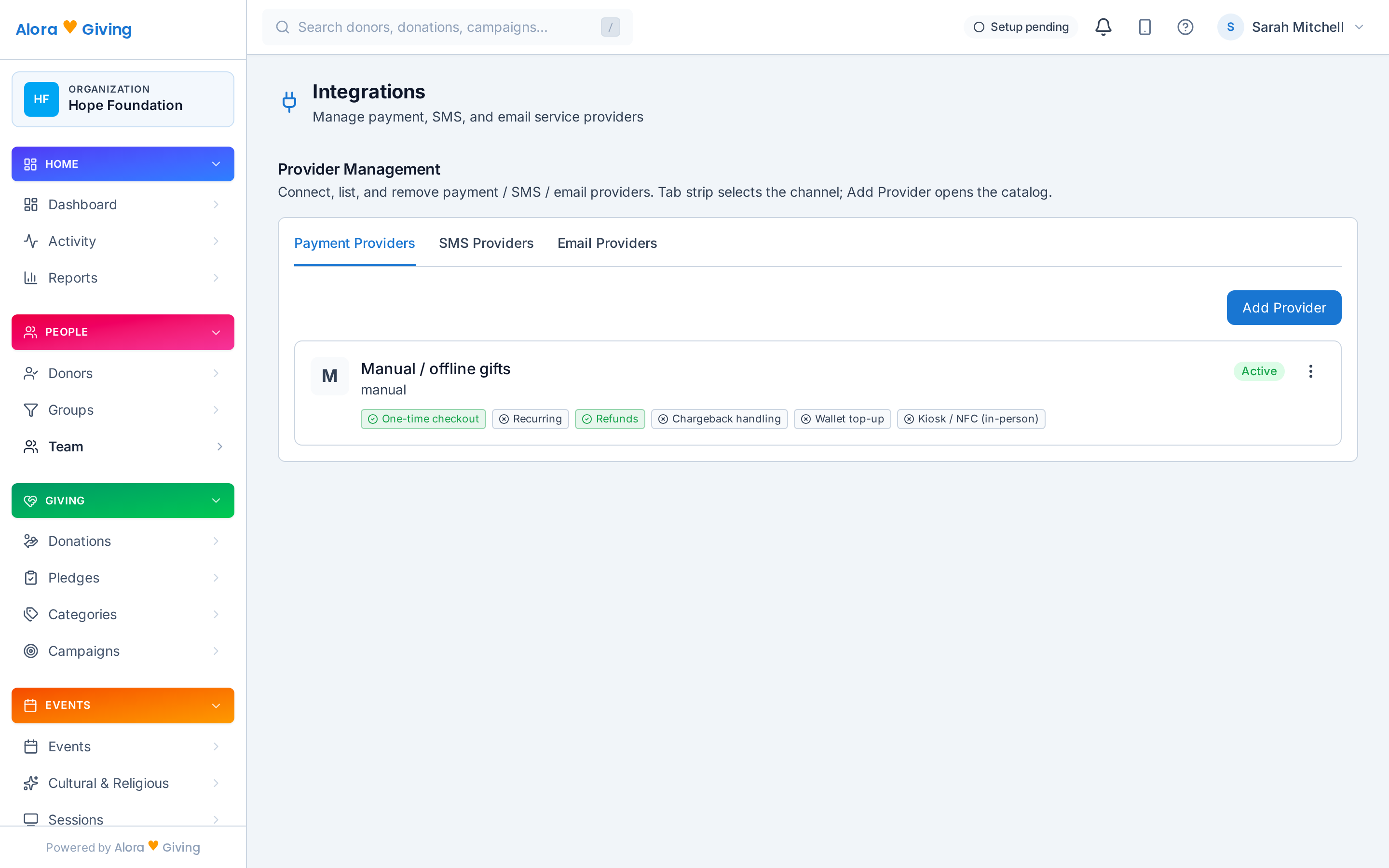
Abstract adapter interface with 19 third-party rails in production. Stripe and PayPal for global cards. Razorpay for India. pawaPay for African mobile money. bKash, Nagad, and SSLCommerz for South Asia. dLocal for Latin America. Xendit for Southeast Asia. Moyasar for Saudi Arabia. Manual entry for cash, check, and wire. Adding a new provider is a configuration — write an adapter, register it, and organizations can select it from their dashboard.
Live SMS routing in Bangladesh today via SMS.net.bd. Adapters for Twilio, Infobip, Africa's Talking, and MSG91 ship with the platform, ready for regional rollout as routing goes live market by market.
SMTP by default — works with any email server. SendGrid, Mailgun, and other transactional email services can be added as adapters. Org-customizable Jinja2 templates stored in the database.
Built-in today
19 third-party payment rails plus manual entry ship with the platform — alongside SMS adapters (live routing in Bangladesh today, more markets rolling out) and universal SMTP email — covering 40+ countries. More are added based on where organizations need them.
Localization
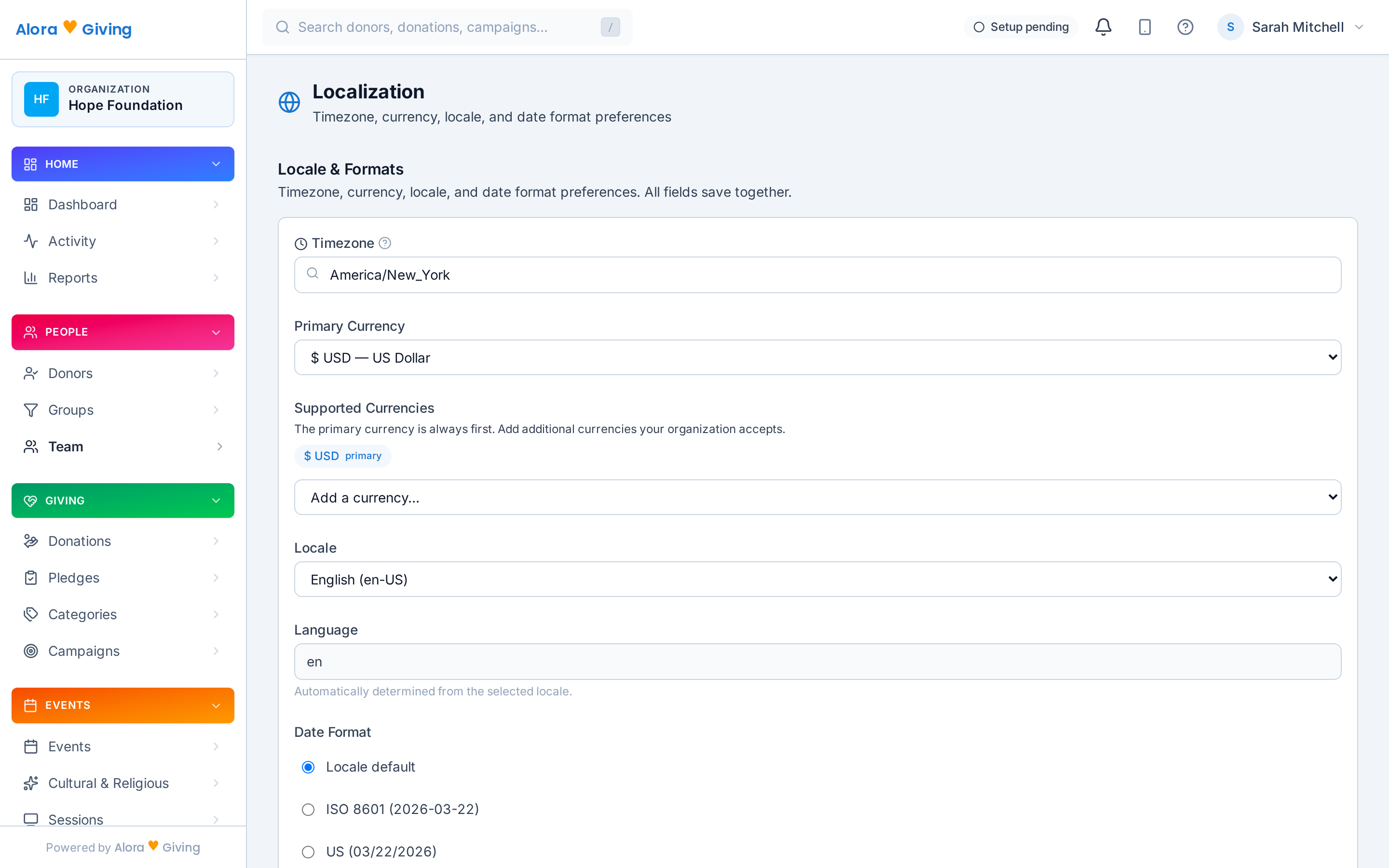
Currency formatting, date formats, timezones, and tax receipt standards all adjust per organization. The product UI is in English today — 14 supported locales (including Arabic, Bengali, Hindi, and Swahili) handle regional formats, currencies, and dates, with more UI languages on the roadmap.


Our commitment
Today we have 19 third-party payment rails in production (plus manual entry for cash, check, and wire) covering 40+ countries — from Stripe and PayPal for global card processing to M-Pesa via pawaPay in East Africa, UPI via Razorpay in India, PIX via dLocal in Brazil, and mobile wallets across South Asia. The architecture remains provider-agnostic — adding a new payment method for any country is still a configuration, not a rebuild.
Our goal is to make modern fundraising tools available to every nonprofit on the planet, regardless of where they operate or how their supporters prefer to pay.