Alora Cultural Intelligence (ACI) is what happens when a donation platform stops pretending one shape fits everyone. ACI resolves your organization across seven dimensions, then configures vocabulary, calendar, giving frameworks, and communication tone to your community's tradition — automatically, the moment you sign up.
The problem with generic platforms
A church admin shouldn't have to translate "donor" to "giver" in her head every time she logs in. A synagogue treasurer shouldn't have to manually map fiscal-year deadlines onto the Hebrew calendar. A foundation shouldn't have to explain to a generic CRM what a restricted grant is. The platform should already know.
How ACI resolves your organization
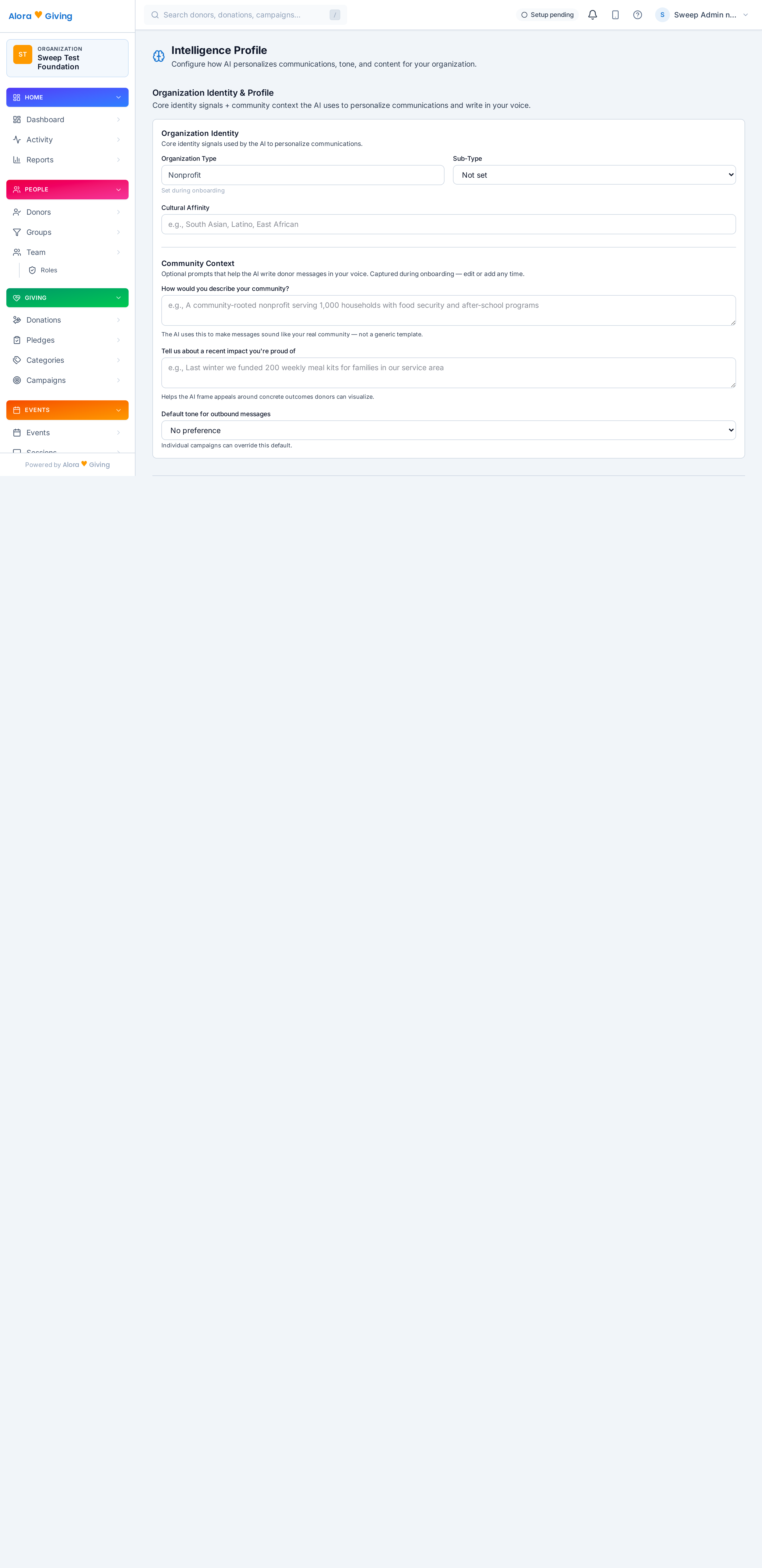
Cultural intelligence starts with a precise model of who you are. ACI resolves every organization across seven dimensions — and every downstream choice the platform makes keys off that profile.
Vocabulary overlays
Same database. Same features. Different words. ACI's vocabulary overlays rename the product's nouns across all 13 surfaces — dashboard, donor portal, widgets, donate pages, email, PDF receipts, SMS, push, in-app, announcements, kiosk, mobile, and live event pages.
| Donations | Gifts |
| Donors | Givers |
| Sidebar section | Stewardship |
| Recurring | Recurring gifts |
| Campaign | Initiative |
| Donations | Tzedakah, contributions |
| Donors | Congregation, members |
| Sidebar section | Tzedakah |
| Recurring | Recurring tzedakah |
| Campaign | Appeal |
| Donations | Seva, dakshina, daan |
| Donors | Devotees, sangat members |
| Sidebar section | Seva (or community-specific term) |
| Campaign | Initiative, appeal |
| Donations | Gifts, grants |
| Donors | Donors, funders |
| Sidebar section | Fundraising |
| Campaign | Campaign, program |
Capability packs
Cultural intelligence isn't a coat of paint. When ACI activates a capability pack, the product itself changes — fund designations, seasonal automation, checkout flows, even text direction.
Zakat, sadaqah jariyah, and waqf designations kept cleanly separate; Ramadan auto-campaign drafts; riba-free language throughout; right-to-left script support.
Advent and Easter seasonal automation — with the Western/Orthodox date split handled correctly — pledge-card flows for commitment campaigns, and tithe, building, and missions fund presets.
Yahrzeit remembrance giving, tribute and dedication flows, High Holy Days seasonal templates, and the Hebrew calendar woven through dates and schedules.
More packs cover the other traditions ACI models — and interfaith organizations can run different packs per program.
Devotional recurring schedules
Donors pick a devotional rhythm at checkout, and the platform schedules each charge on the tradition's own clock — computed against the right calendar, every cycle.
Every devotional intent carries an expert-attestation status — donors see an honest "cultural guidance under review" label until a Subject Matter Expert signs off.
Seasonal intelligence
226 seeded observances across 10 calendar traditions. The platform knows your community's calendar and surfaces upcoming observances as draft campaigns — you approve, it ships on time.
Plus Bahá'í, Jain, and Zoroastrian observance sets — 226 observances in all, resolved by eight calendar-system plugins. Explore the multi-calendar engine →
For interfaith and multifaith communities
University chaplaincies, military religious-services programs, prison ministries, hospital pastoral care, hospice chaplaincy — your community isn't one tradition. The platform doesn't make you pick.
Configure multiple traditions side by side. A campus that supports Christian, Jewish, Muslim, Hindu, Buddhist, and secular humanist programs runs them all from one dashboard — each program's donors see vocabulary appropriate to their tradition, each program's seasonal calendar populated correctly.
Interfaith solution details →The SME review system
Vocabulary mappings, seasonal templates, devotional schedules, communication tone — none of it is hardcoded by a software team in Silicon Valley. ACI ships with a built-in review workflow: credentialed Subject Matter Experts — scholars, clergy, and cultural experts with real identities and scoped review domains — examine cultural content and attest to it. And the product is honest about status: content still awaiting review carries a visible "cultural guidance under review" ribbon until an expert approves it.
Platform curator or org admin submits a cultural overlay — vocabulary entries, seasonal events, communication tone for a specific tradition + region.
The platform assigns the overlay to an SME whose expertise matches: tradition, region, language. SMEs are real people, vetted, accountable.
SME reads, comments, requests changes, withdraws, or approves. Every decision is captured with rationale. Full audit trail.
Approved content carries its expert attestation; until then it stays visibly marked as under review. Future orgs signing up with that tradition + region get the reviewed content automatically.
Your organization can also nominate its own SMEs for tradition-specific content review — turning leadership at your community into authorities on what the platform says. We claim the review system, not blanket certification: some content is still pending review, and the product shows it.
Under the hood
Cultural Intelligence isn't a feature flag. It's an architecture. Four layers, each doing one job, never confusing your data with anyone else's.
Tradition, region, denomination, size, history. Built from your signup choices and refined by your actual giving patterns. Stays inside your tenant — never shared.
Donor lifecycle stages, giving cadences, seasonal peaks. Inferred from your data, used only for your data. Drives autopilot recommendations and at-risk-donor flags.
Campaign copy, message variants, thank-you wording. Anthropic Claude composes drafts tuned to your tradition + your patterns. Staff reviews; AI doesn't autosend.
Coming: privacy-preserving comparisons against similar-size organizations in your tradition — aggregate only, never individual donor data. On the roadmap, not live today, and we won't pretend otherwise.
Your data, your scope
Your donor records are yours. The platform never trains a model on your data, and never shares your data with other organizations. When cross-org benchmarks ship — they're on the roadmap — they will be privacy-preserving aggregates only; individual donor records are never exposed.
Security & data governance →